Viva Las Vegas was sung by Elvis Presley on his tour in Las Vegas. Well, we were no longer able to see or hear him, the famous rock star died on August 16, 1977, when we passed by there on the way to our cruise. By then we had already flown from Frankfurt to Miami, and from there to Las Vegas. We had a look at the hustle and bustle, which isn’t for everyone. But Las Vegas is a good starting point for Death Valley and the Colorado Gorge, the Gran Cannon. Seeing this is a must.
Our cruise began in California, in San Diego. We already knew the ship, the Vision of the Seas from Royal Carribian Cruise Line, from before. We sailed down the Pacific coast, through the Panama Canal and then north through the Gulf of Mexico back to Miami. Yes, if only our wife Eleonore hadn’t had an accident immediately after leaving for the Gulf.
And so the focus was less on the cruise and more on what to do when someone can no longer travel. Nevertheless, the impressions of Central America are not neglected.
To Miami, Florida, November 24, 2014
Just a hotel to spend the night
Anyone arriving from Europe with 10 or more hours behind them really only wants one thing: peace and quiet. And if you have found the right “cab” level at the airport and hired a blue cab – the yellow ones are not responsible for short trips (ask the dispatcher) – you can reach your destination for 15 dollars + tip. You can also ask for the shared shuttle to the hotel. The hotel was in a quiet location, large rooms and beds. The continental breakfast is generous. Where else can you make your own waffles? For the onward flight the next day we got the shared shuttle (free of charge). For those who have time, you should try public transportation. There is a bus to the nearest S-Bahn station, but which way should you get on, there is a busy 6-lane road between the stops. We gave up and, as I said, took the shuttle. Well, we still had time.
Miami, Florida, November 25, 2014
To Bayfront Park in downtown Miami
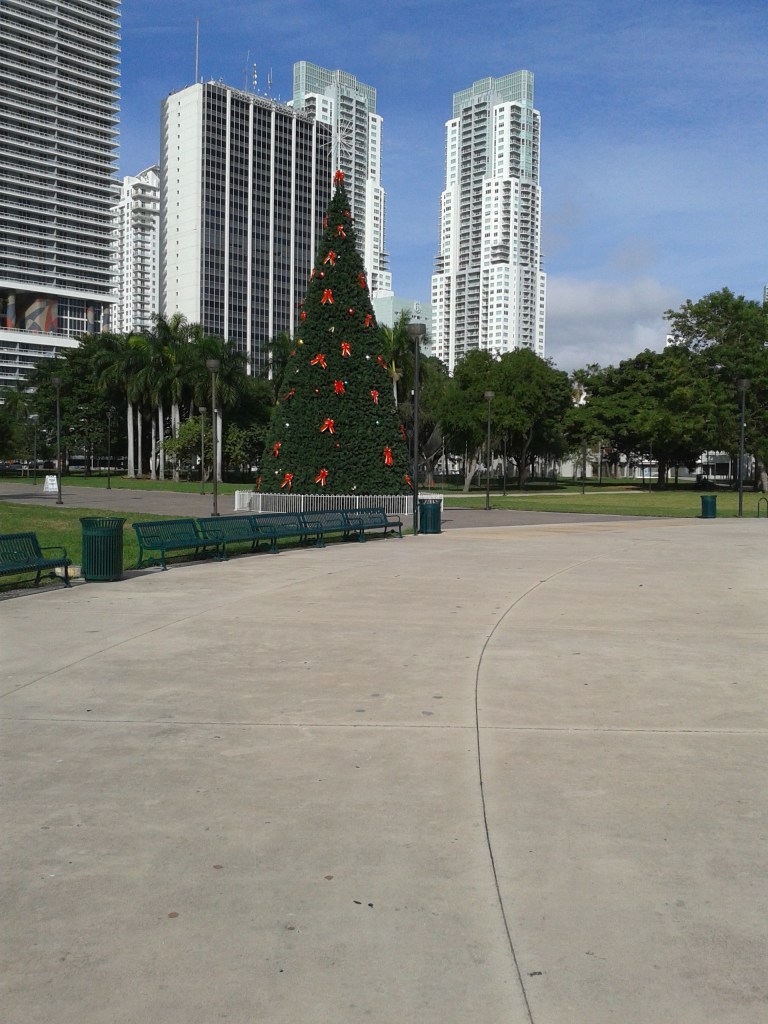
If you are waiting for your flight and don’t want to spend hours bumming around in Miami International Airport, unless you learn Spanish from the numerous announcements, you should do the following: Leave your suitcase with the airline in advance, leave your hand luggage at the baggage storage in Terminal E for $6 per day per item, go to the air train and take it to the train station. Buy a day pass from the vending machine for $5.35 and take the red line to downtown. The train (S-Bahn) comes every 10 minutes. Get off at the Gouvernement Center station and take the Miami City Mover (free monorail called the Miami-Dade Metromover) next to it. Get off at Bayfront Park on the circular route. Walk into the park to the water, visit the mall, go to the Hard Rock Café or take a short boat tour. For the return trip, allow 1 hour to get to the gate. Have fun. And if you look around, the Christmas tree is already up, a bit strange in the tropical surroundings.
Our flight to Vegas was in the afternoon, 5 hours and 30 minutes. Just in time to take photos as we flew over the Gran Cannon. The runaway bus took us to the hotel. The driver held out his hand for the good tip, like everyone here, he said.
Las Vega, Nevada, Florida, November 26, 2014
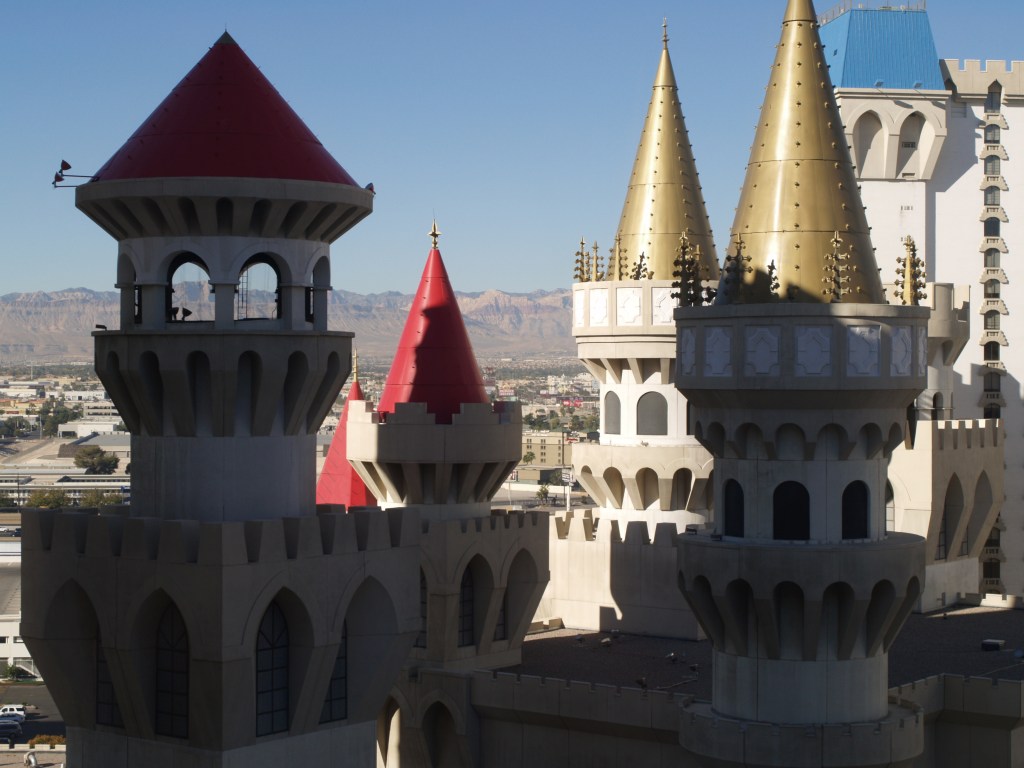
King Arthur would turn in his grave, but this is Las Vegas
No – it’s not a Camelot, even though it looks like one. It is a cheap mass accommodation (3,000 rooms) in the middle of a huge entertainment mile, the Strip. If you want to leave your children in the Fun Dungeon or better still play in the knights‘ games in the basement, this is the place for you. The low accommodation price is one thing. But you get spacious rooms and beds, everything is good and clean. The expensive food and drink make up for this. Pizza for 20 $ with queuing, the 3 courses in the restaurant for 50 $ are a bargain (Onion Soup, Sirlion Steak, Chocolate Cake, a beer). Reception with queuing, but the concierge was good. This was too much for 4 nights. If again, we’d rather go to the New York-New York next door.
The Deuce double-decker bus
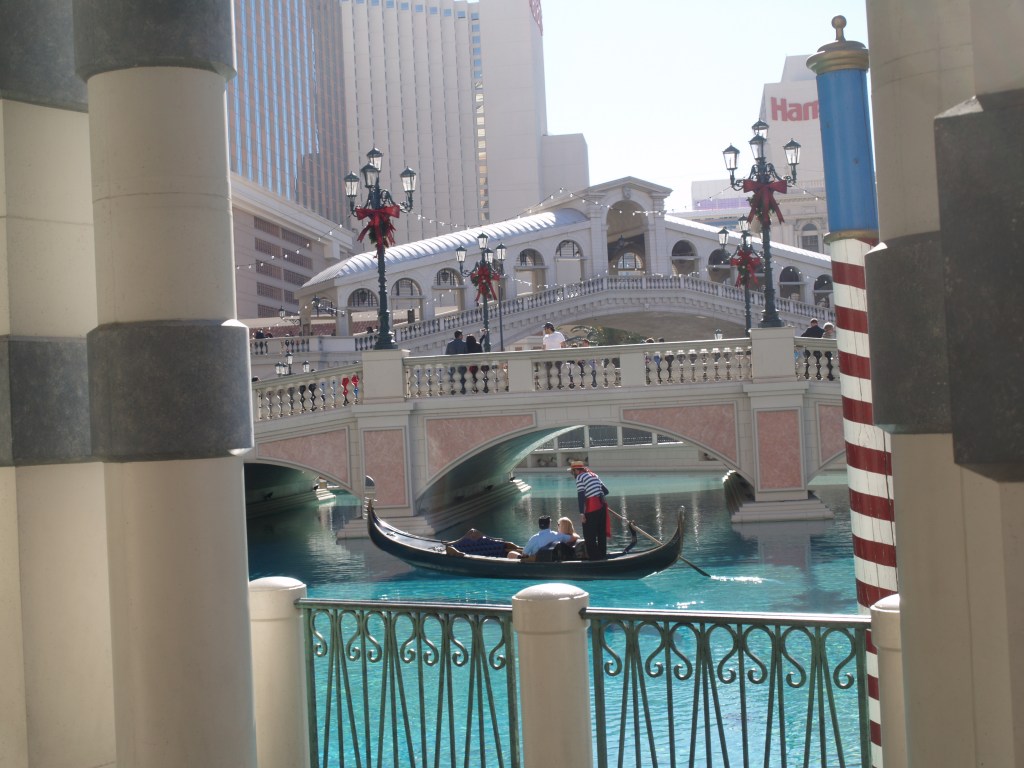
If you don’t want to “walk” the whole Strip (part of Las Vegas Boulevard), which is 6.8 km, take the “Deuce” double-decker bus.) Tickets are only available from the driver in exchange for bills. Candidates with better administrative skills and good English elicit the tickets from the ticket machine. 8 dollars for 24 hours. That’s enough for 2 round-trips. During the day, we recommend the trip from the south (Mandalay Bay Hotel with shark watching) to the north (Stratosphere Tower Hotel with people voluntarily abseiling from a height of 350 m). On the way back, be sure to stop at Venice Las Vegas (you don’t even need to visit Venice, much better). In the evening, the ticket is still valid, up to the Eiffel Tower Las Vegas (16 $), better than going to the shows, then marvel at the volcanoes in the Mirage Garden. Finish off at the Seven Fishermen in New York-New York (outdoor restaurant with a view of the Brooklyn Bridge Las Vegas). Cheers.
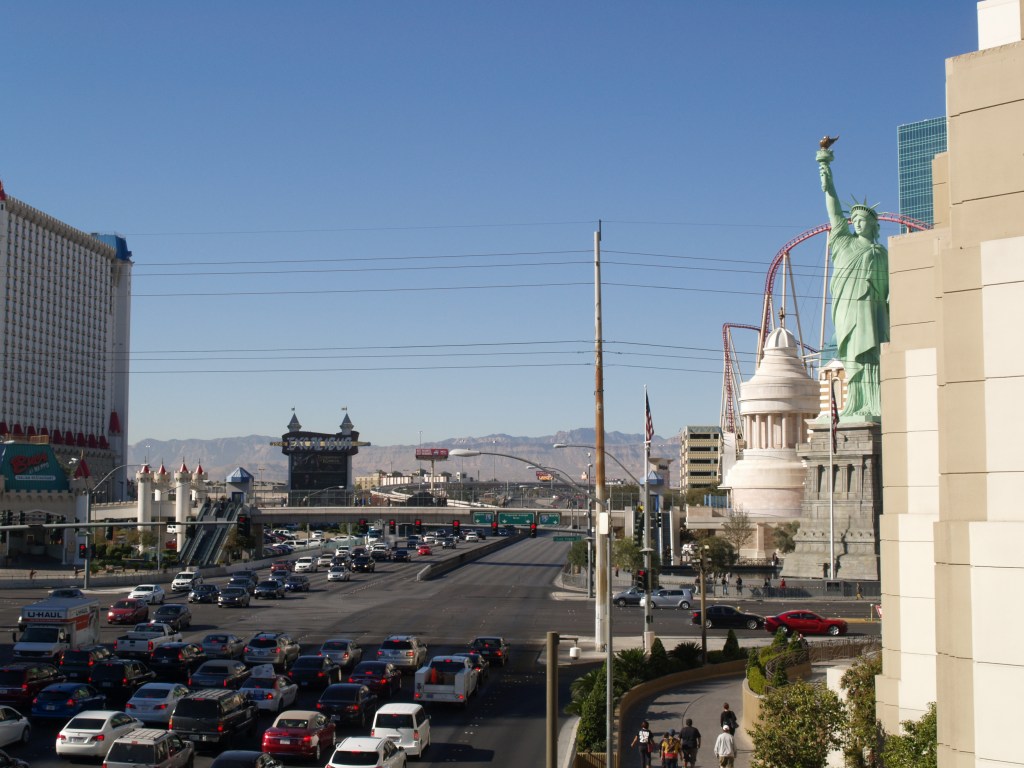
The Sphinx on the boulevard or rather the Rialto Bridge
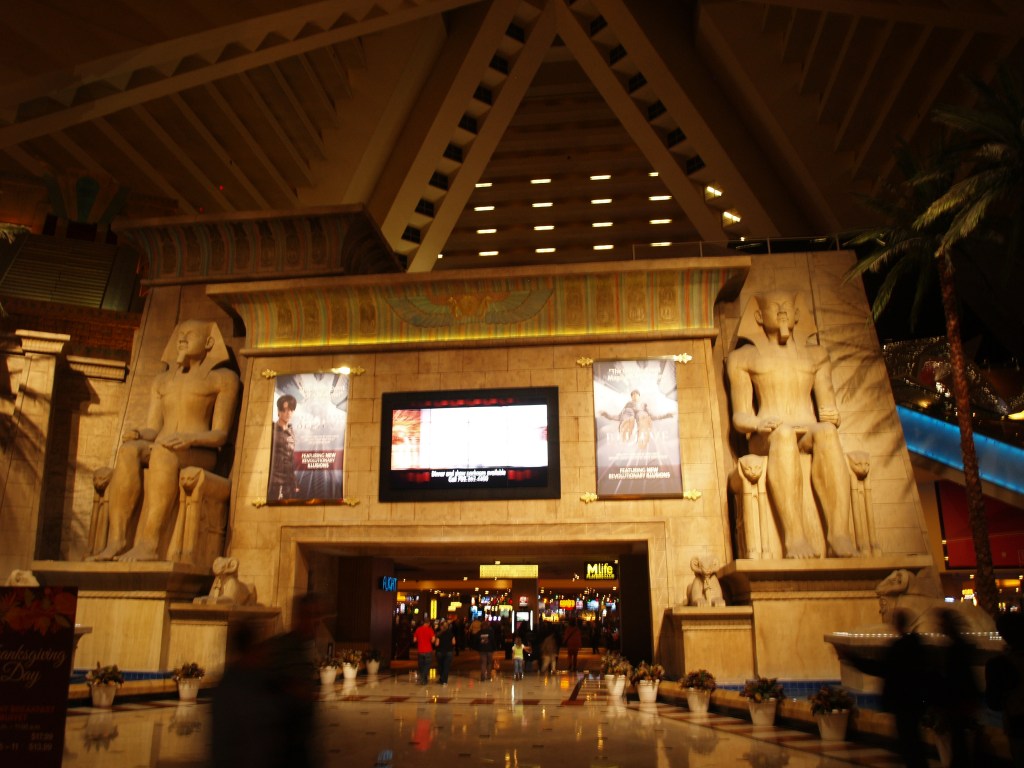
It is impressive in the evening, the black pyramid with the steel spotlight at the top, Luxor with a difference. The size of the statues (Valley of the Kings) shouldn’t be the reason either. The casino, which fills the inner square, is comparatively quiet, unlike the Excalibur next door. We couldn’t figure out what the large model of the Titanic was doing here. The rooms are arranged in galleries on the inside. You have to figure that out. And the Sphinx watches over the boulevard. A copy of the Rialto Bridge crosses the boulevard a few kilometers to the north. This is part of “Little Venice”, the Venetian Resort Las Vegas. From the boulevard into the gondola (with singing) into the shopping arcade a la Canal Grande. This is Las Vegas.
A splendor inside and out
This is probably the best casino and hotel in the whole of Las Vegas, a splendor inside and out. And you don’t have to want to gamble, or perhaps take a gondola ride to the shopping mall. It has everything the real Venice has to offer: St. Mark’s Square with its campanile and lion, the Rialto Bridge over the boulevard, the gondolas, the palazzi including their lavishly painted ceilings. Everything, only more beautiful. There’s nothing left for New Year’s Eve. Across the street at Caesars Palace is still possible. 830 dollars a room.
Las Vega, Nevada, Florida, November 27, 2014
By plane to the west rim of the Grand Canyon, skywalk included
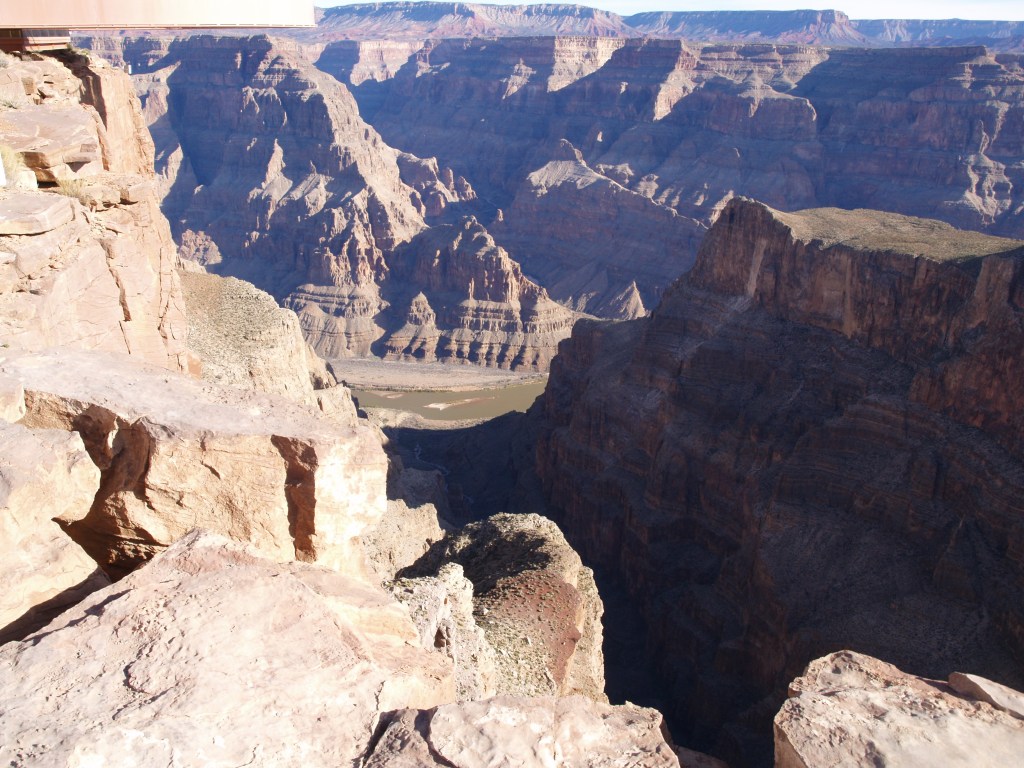
To start with, the flight to and over the Grand Canyon was the best. The rest was good at best. But right from the start. We were picked up from the hotel and then boarded an 8-seater plane, a single-engine Piper. The pilot, flight attendant and guide by the way, flew a big loop over the Hoover Dam and then to the west rim of the canyon. A wonderful flight, so it wasn’t a waste of money. The Hualapai Indians have built an airfield and visitor center at the West Rim. A circular bus takes you to the various attractions: the ranch, the Skywalk, Eagle Point and the Guano View, all on the edge of the canyon. We found the Skywalk disappointing, but it is a must for people who want to have more than 1000 m of visibility under their feet. The $36 is not worth it, better to stand on the cliffs of Eagle Point and carefully look for the Colorado below. Further along the circuit we had lunch at Guano Point. If you have a red ribbon, you can get your food and drink from the canteen, sit down at the edge of the gorge and refuse the big ravens your food. The remains of a cable car station stand on a ledge. The cable over the canyon was torn away by a fighter jet. The view from there is exhilarating. Our pilot swung us home and we were back at the hotel in the late afternoon. We booked the excursion via Viator from home. You can also book excursions anywhere in Las Vegas, but we don’t know how much they cost.
Tomorrow we have our excursion to Death Valley. And after visiting the Gran Cannon, we still had enough time in the evening to see Las Vegas from above. The best way to do this is on the replica Eifelturn. It belongs to the Hotel Paris, who else? Although it is only half as high as its big brother, it offers a unique view of the Strip. On the way back to the bus stop, we discover a special kind of advertisement. Machine gun shooting, what can you say about that. Let’s take a look at the hustle and bustle on the Strip and go for a drink. Alcohol is public in Las Vegas, just like shooting.
Las Vega, Nevada, Florida, November 28, 2014
If Death Valley, then go here first
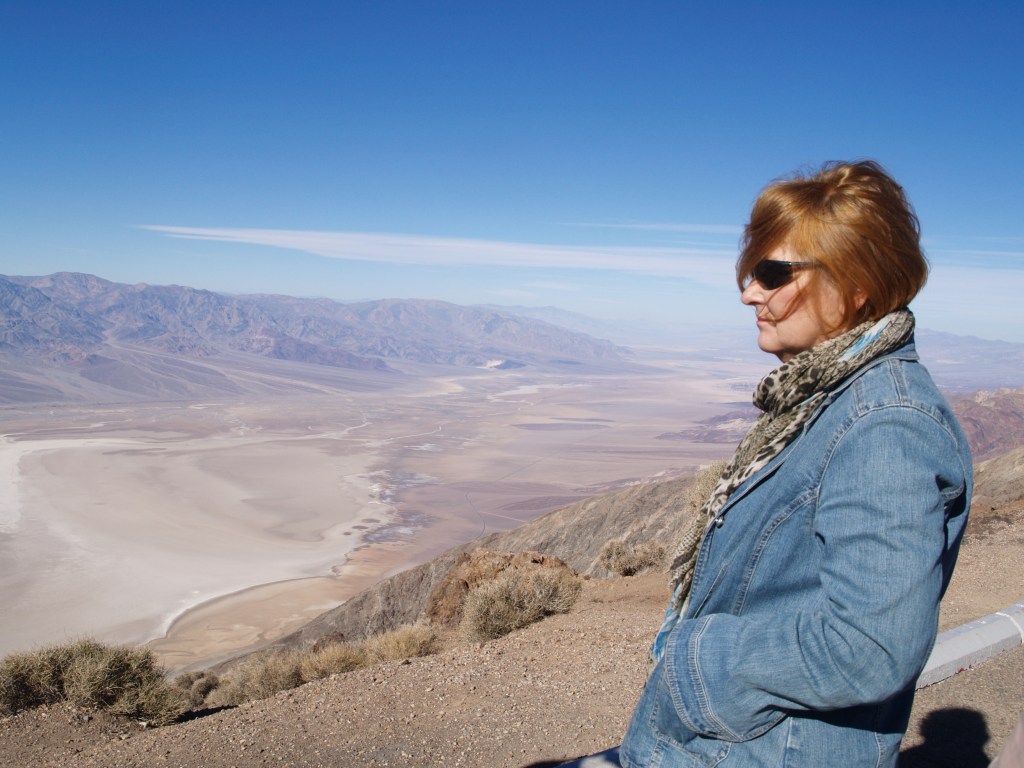
We set off from the hotel in Las Vegas, just under 3 hours to Death Valley, with a stopover. Even the drive there wasn’t boring, the driver told us a lot about the small opera house on the way. Once we arrive, let’s see what it looks like when it only rains once every 10 years. And then there’s the Totes Valley, which used to be a sea five million years ago. An experience. But there’s more to come: to Furnace Ranch to freshen up, Badwater Basin, Devil’s Golf Course, Zabriskie Point, etc. In the evening, with a few more impressions, we were dropped off safely at the hotel.
An oasis in the Dead Valley
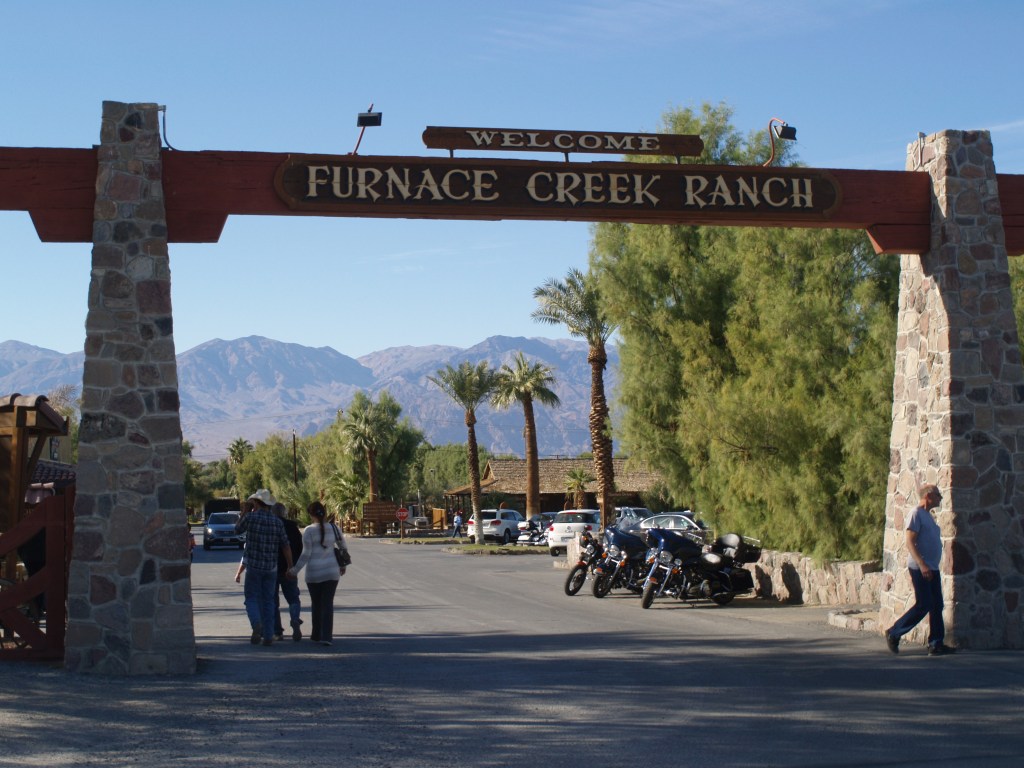
Situated on Highway 190, you simply can’t miss it. If only to go to a decent toilet. We took a lunch break there and then went to see another sight. You can eat well chilled, play golf, spend the night or visit the small borax museum, which has everything from a complete locomotive to the skeleton of a stagecoach. In front of the entrance is an old locomotive with wagons for transporting borax. That always saved the 20 mules to pull it. Always good to take a break with a walk around the resort. By the way, when we were there, the thermometer showed 75° F, which is just 24° C.
Who doesn’t think of flower power when they think of Zabriskie Point
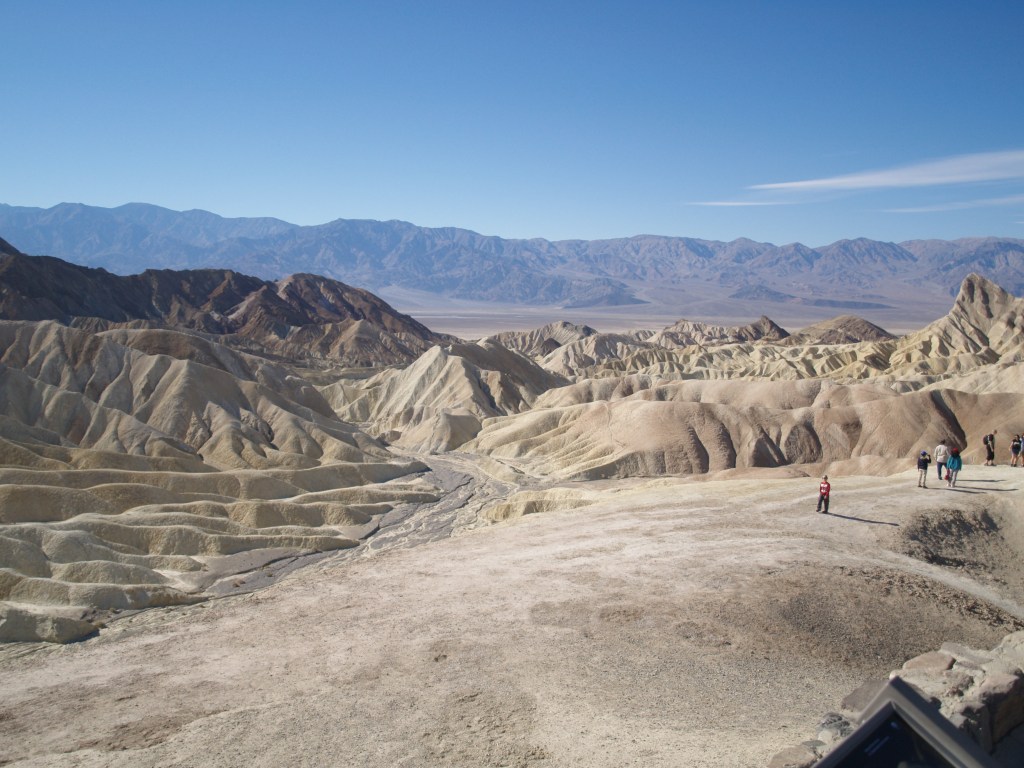
Older people know the movie of the same name from the Flower Power movement. When we saw the millions of years old sediment deposit, the film immediately came to mind. It’s all prehistoric mud, said the guide. It is an extraordinary environment, even for falling down.
It doesn’t get any deeper in America
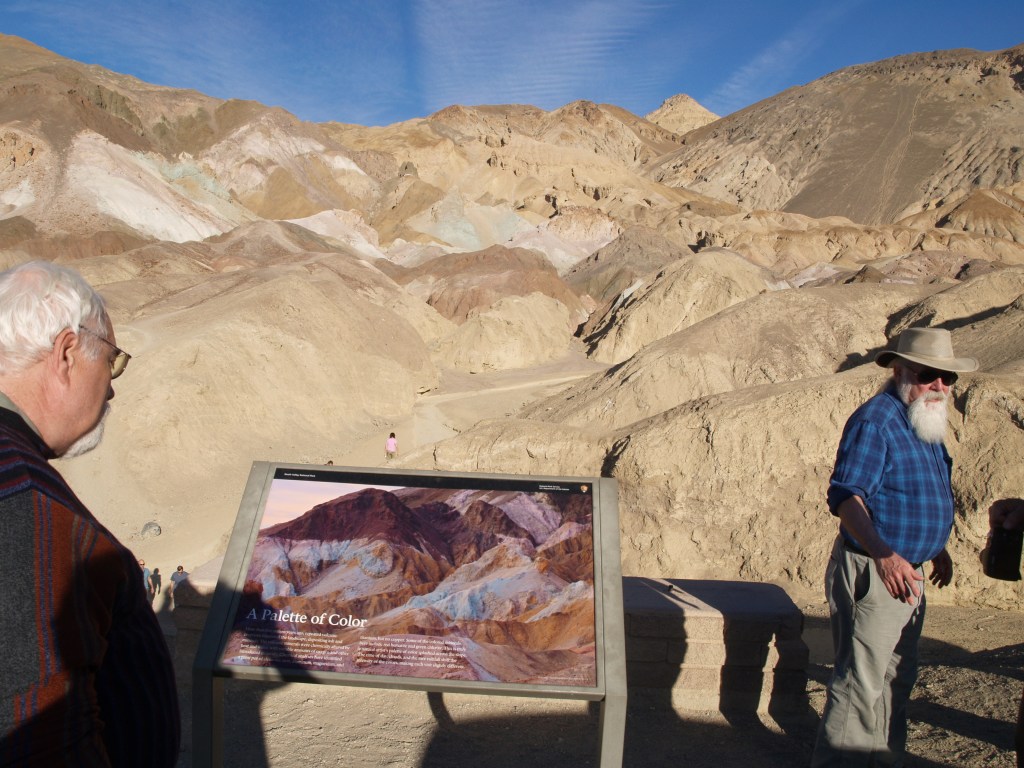
Badwater Base is one of the attractions in Death Valley. Actually, there is only a prehistoric sea level to admire. But it’s the depth that counts, 86 m below normal level. If you look up at the rock face opposite, you can see the sea level. A sign provides information about the monthly maximum and minimum temperatures. It is said to be at its best before sunset and after sunrise. There is also another attraction in the valley: A Palette of Color. Of course, you have to see both.
With the roller coaster through the casino
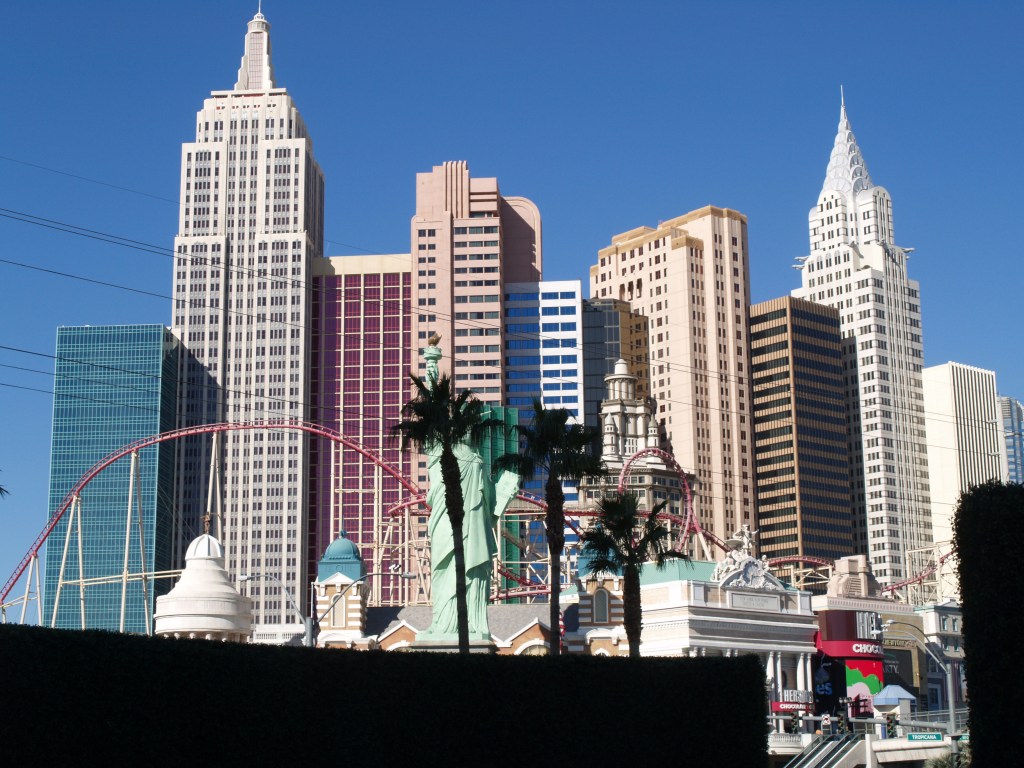
We actually wanted to race through the casino and out through the Manhattan skyline. But then we decided not to. We walked through the huge gambling hall, then visited the cardboard alleyways of New York around 1900. We got fish and chips, which is surprisingly cheap, and a Coke. Finally, we ended up in an Irish pub for a Guinness and a cider. If we come to Las Vegas again, we’ll spend the night there. And then we’ll ride the rollercoaster out of the casino, past the Statue of Liberty and the Chrysler Building. We’d love that.
To San Diego, California, November 29, 2014
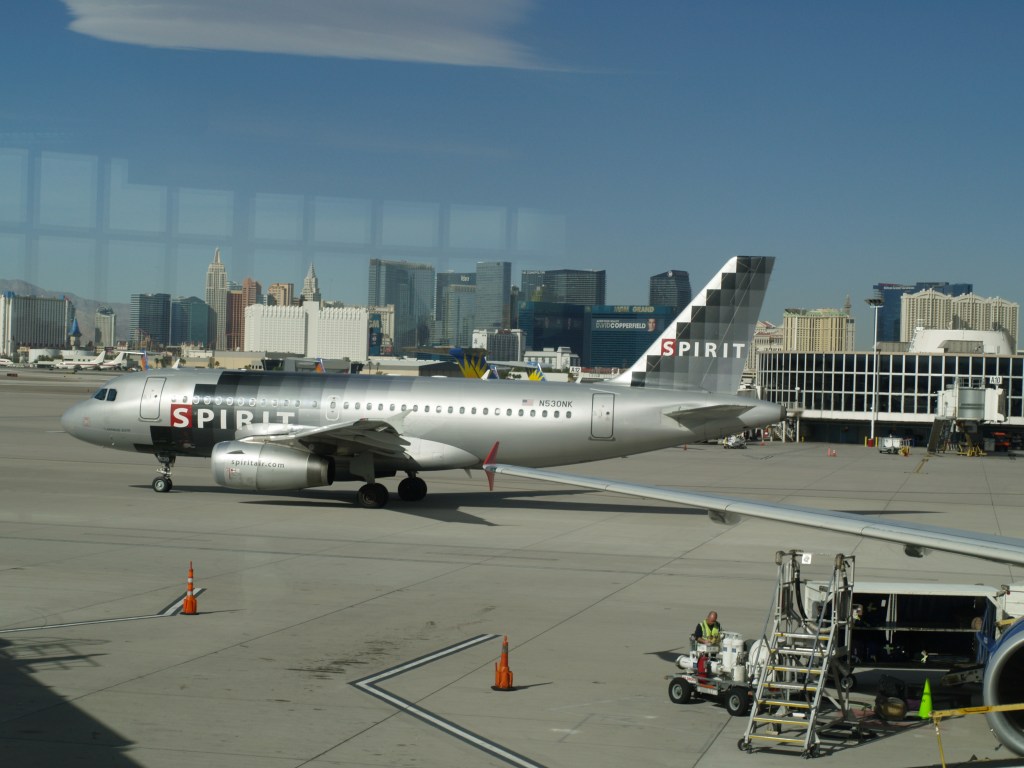
Today we fly to San Diego, where the embarkation port for our cruise is located. We stand in the terminal and look out over the Las Vegas skyline, which is formed by the various hotel buildings. Then we set off over the Sierra Nevada. In the plain in between, you can see a solar power plant flashing from the airplane. Finally, we have landed. We found out how to get from the airport to the city from the map given to us by friendly older ladies at the terminal.
We were right
We chose the slightly more expensive hotel because it was conveniently located on West Broadway. A few blocks away is the Gaslamp Quarter (the entertainment district), the suburban train to Old Town (Santa Fee station, from where you can also take AMTRAK to LA) and the pier where the cruise ships dock. The 992 bus goes right across the street to the airport, 20 min ride for a senior-friendly $1.10.
The hotel is spacious, with an outside elevator that goes up to the restaurant. The room was luxurious, everything was spot on. Super staff, came straight away with a town map. A great recommendation.
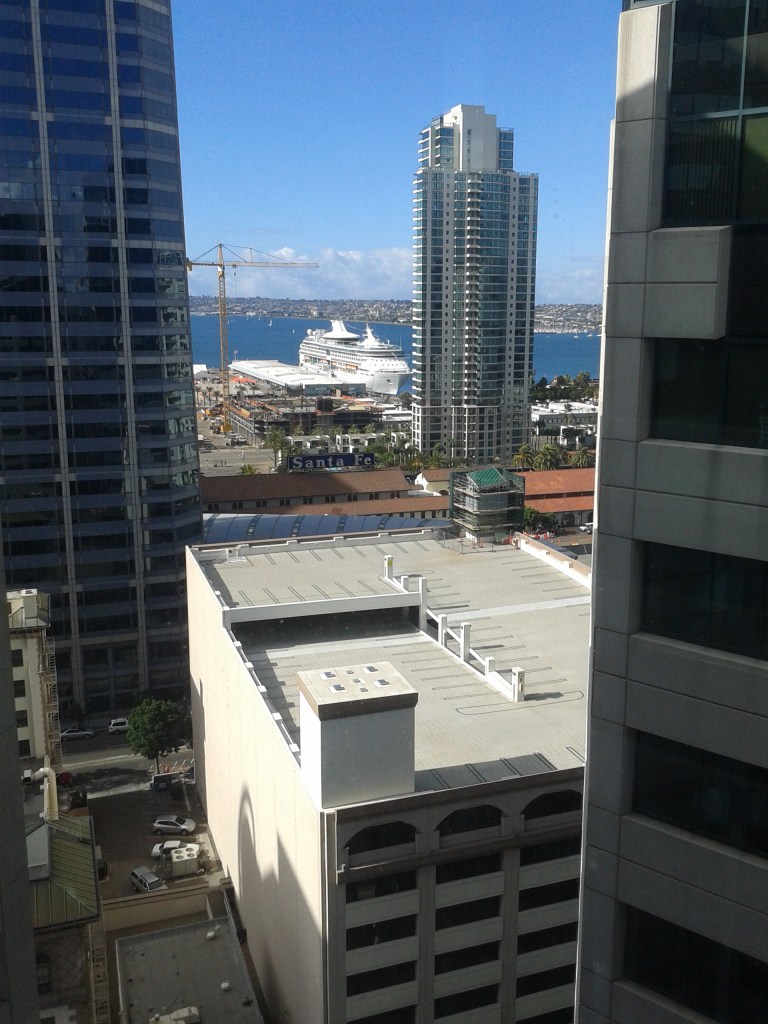
And we could already see the cruise ship from there
In the room we found a picture book of San Diego. It spoke highly of the Gaslamp Quarter. The receptionist also recommended it to us for our evening stroll. It was just around the corner. We set off and found a nice restaurant with Mexican cuisine. I can’t remember which one, there are quite a few. Possibly the one in the photo. The food was great, we were looking forward to our decision and were in anticipation of what tasty things we would get to eat at the destinations.
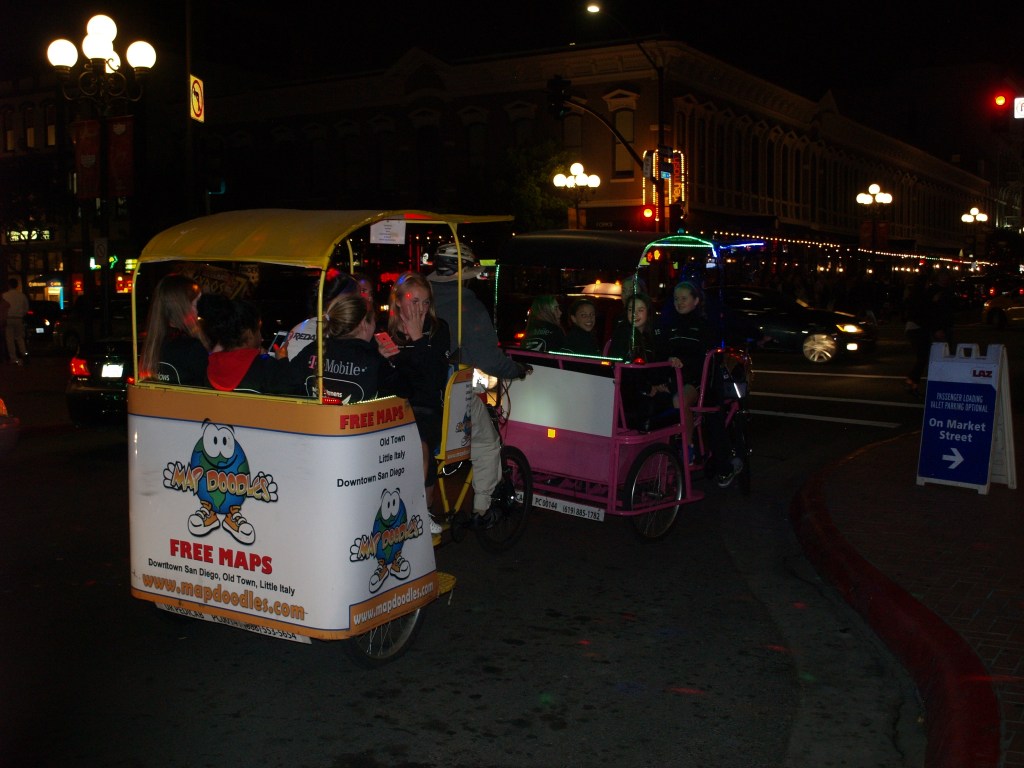
San Diego, California, November 30, 2014
Everything is pretty to look at, just walk around
The Old Town is the cradle of the Republic of California. Easy to reach via the green S-Bahn line, after 4 stops from Santa Fee. The one-way ticket costs 1.25 dollars, for seniors. From there, everything is signposted. (Historical) buildings are grouped around a large square (flags). Today they are stores or restaurants, there is also a small but interesting museum, Wells Fargo stagecoach, justice of the peace, sheriff etc. A street with stores and restaurants leads off the church on the square (built around 1850), all very Mexican. We had a very good breakfast somewhere. And some of the buildings were festively decorated with Fiesta de Reyes, meaning the 3 Kings Festival, as it was already getting closer to Christmas.
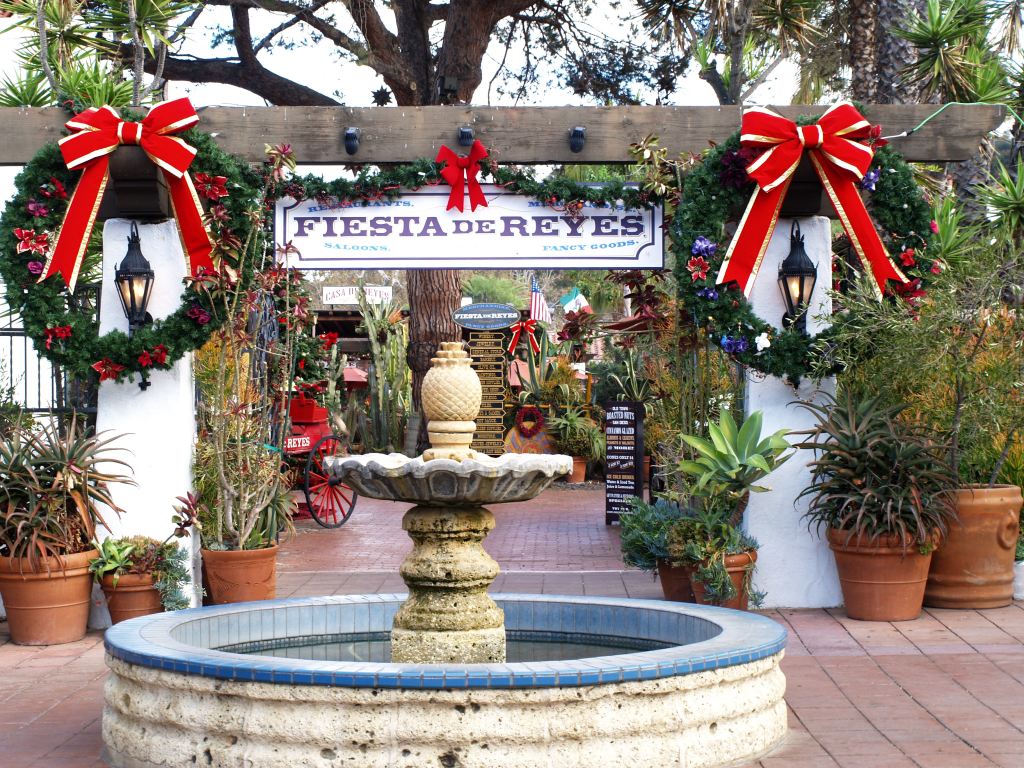
There was never a dull moment in the Old Town and we were almost too late for the cruise ship. We actually wanted to see the aircraft carrier Midway, which is a museum ship right next to it. We’ll do that next time. Then we also got used to the American language, which is predominant in California.
In the afternoon we boarded the ship, which we already knew from before. We had to wait a little longer, our cabin was still being made. A little chat with an immigrant lady (gamer) and her American (much younger) husband. Then we were given the Cruise Compass, the ship’s journal, a sign that our cabin was ready for occupancy. In the evening we left for Mexico.
At sea to Cabo San Lucas, Mexico, December 1, 2014
We’ve now been on the road for a good week and have time to reflect on what we’ve experienced so far. We have crossed the American continent, made a stopover in Las Vegas and spent some time in California. We were already familiar with Miami, but it’s always nice to stroll through Market Place Bayside. Then the days in Las Vegas, the hustle and bustle there, but it was nice in the evening. Because the two excursions that everyone must have done at least once. The flight over the Colorado Cannon to the Rim and the drive through Death Valley. The pictures are unforgettable. The shot in San Diego, everything already had a Mexican touch. It was all so much that we could have flown home from LA. But now the cruise really gets going. Tomorrow we dock in Capo San Lucas in Lower California.
Cabo San Lucas, Mexico, December 2, 2014
Surf to the Sky and a waterfront promenade instead of a shopping mall and Wal-Mart?
Yes – what can you do? The ship is moored opposite a huge shopping mall and an even bigger Wal-Mart, with a 6-lane high-speed road in between (motorcycles have no exhaust in Mexico). So it’s noisy outside, a good 30 degrees and the sun is beating down. Should we go to the well-cooled shops or should we go to the promenade and take a cab for 5 dollars a ride to the Malecon? My wife went shopping, I went to the pool. Or should I have done “Surf to the Sky”? You’re connected to a pressure hose and can lift yourself up to 5 m out of the water.
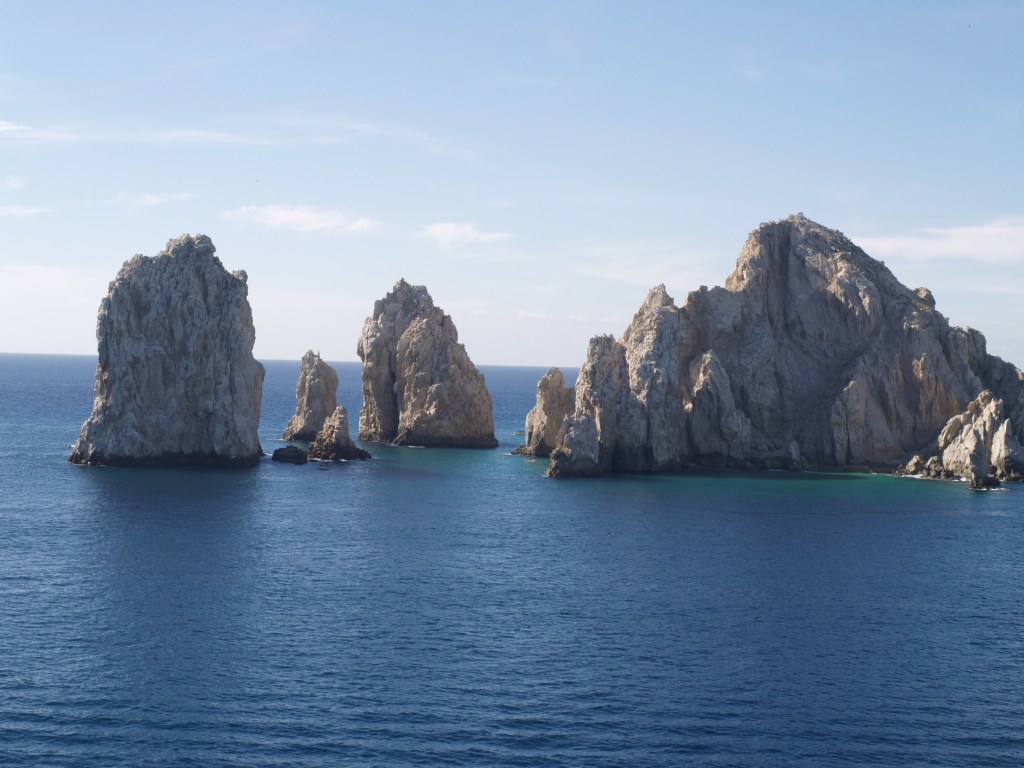
The pleasures of Cabo San Lucas are plenty, writes the Cruis Compass. Let me translate further: When Herman Cortes decided that there was nothing of value in Lower California, he was wrong. There was no gold, but there were pearls, such as beautiful beaches and crystal-clear water. Would you have thought that 400 years later Cabo Sa Lucas would become a gold mine? It started in the 1930s when Hollywood celebrities claimed this as their paradise, accessible by small airplanes or yachts. In the 1950s and 60s, the world grew and hoteliers collected what Cortes had not found.
Puerto Vallarta, Mexico, December 3, 2014
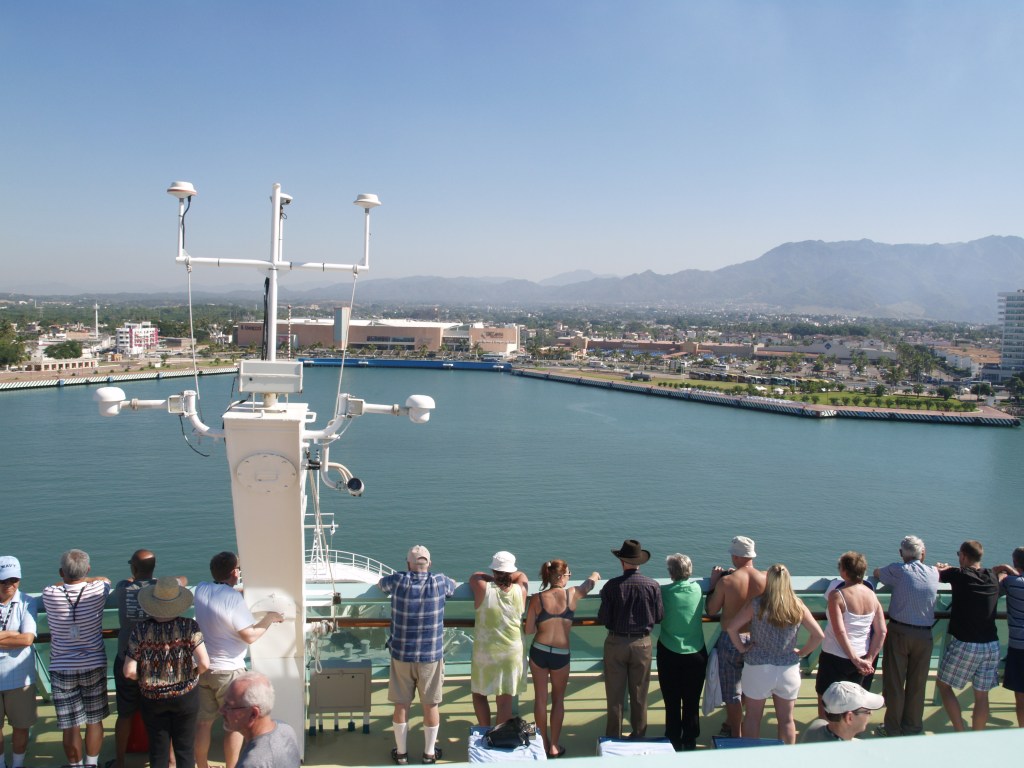
We arrived in Puerto Vallarta at midday today, another Mexican vacation and shopping paradise. I didn’t even get off the boat. The wife did, succumbing to the temptations of shopping and whatever else is going on. When she came back, she just said that I hadn’t missed anything except a huge shopping mall. I had already guessed that from the view from our cabin.
One interesting thing I saw on the pool deck was a sea rescue exercise with a life raft or life raft in the pool. It wasn’t that easy to get in there. And in heavy seas, the life raft might tip over. Passengers had to be back on board by 6:30 a.m. Thank goodness it was only a short visit. I checked the Cruise Compass again to see what we could have expected.
At sea to Puerto Quetzal, Guatemala, December 4 and 5, 2014
Today we are at sea – that was the motto for two days. As education enthusiasts, we listened to the lectures by guest speaker Daniel Schutzer on both days.
HISTORY a. CULTURE WITH GUEST SPEAKER DANIEL SCHUTZER
– The history of Spain in the Americas and its influence in Central America and
the Caribbean – How Spain dominated the region and how and why it
eventually lost its influence. 1:30 p.m., That’s Entertainment Theater, Deck 4.
– History and culture of Central America with a focus on Guatemala and Costa
Rica – How Central America developed from the Spanish colonial period to
modern times 1:30 p.m., That’s Entertainment Theater. Deck 4.
Puerto Quetzal, Guatemala, December 6, 2014
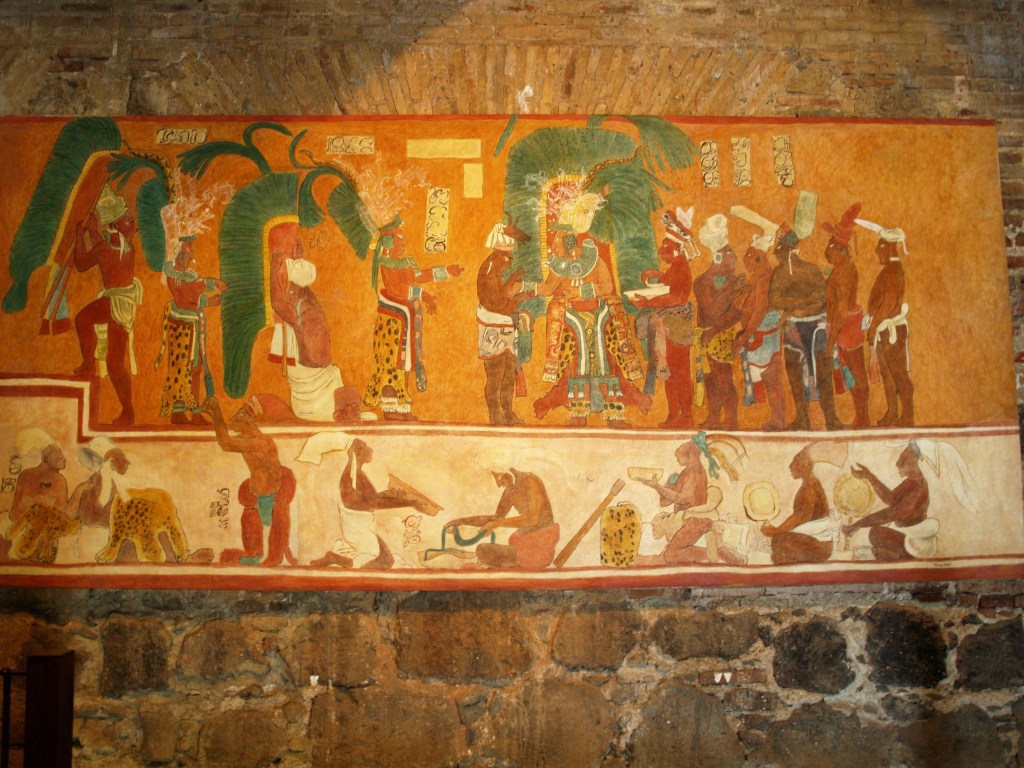
Jade Museum stop
It takes an hour and a half to drive from Puerto Quetzal to the World Heritage Site of Antigua, the former capital of Guatemala. Always uphill into the highlands, past sugar cane plantations and volcanoes (active ones, of course). The stop was the Jade Museum, then we had 4 hours to look around and an hour to find the stop again. But no problem, the tourist police guide you back. In the museum, which is actually a jade factory with an attached sales exhibition, there was hustle and bustle, but no cheering. One bus after another, people wanting to go to the toilet, to the lecture on jade extraction or how best to get around the city. Nevertheless, the museum is great, especially the timeline showing the times when the different peoples existed. Everything is garnished with jade sculptures from the respective era. In 1521 it was over, the conquistadors came and founded Antigua.
Central yet quiet café (in the backyard)
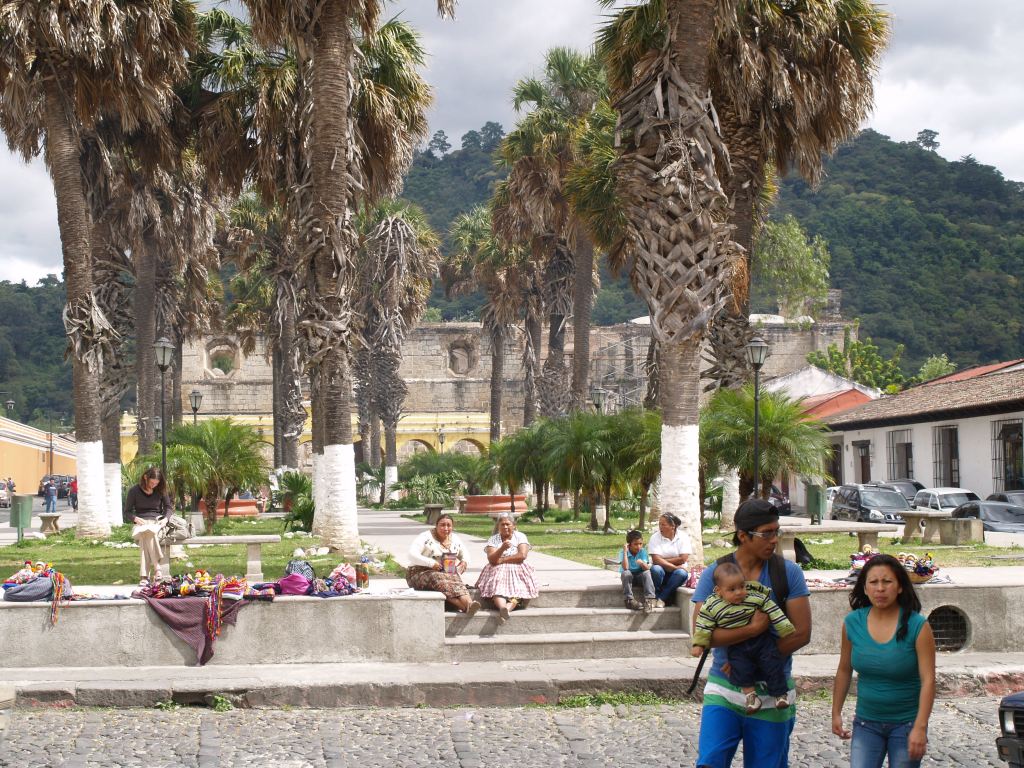
If you want to escape the offerings of the shoeshine boys on the Parque Central, look for the bookshop on the northern side, walk through and you’ll find yourself in a beautifully shaded backyard café (probably an institution in Antigua). We had a typical local lunch (delicious), local beer as recommended (tastier) and couldn’t help but try an (even tastier) slice of cake. The nice waitress could barely speak English, so we had to make do with even worse Spanish. To make up for it, we were given a decent tip, in USD of course. The name of the café comes from the unfaithful countess (Condesa), whose lover the count had walled in (standing). A skeleton was actually found in the old walls. The creepy story should not deter you from visiting the café.
A baroque dream – the Church of Our Lady of Mercy
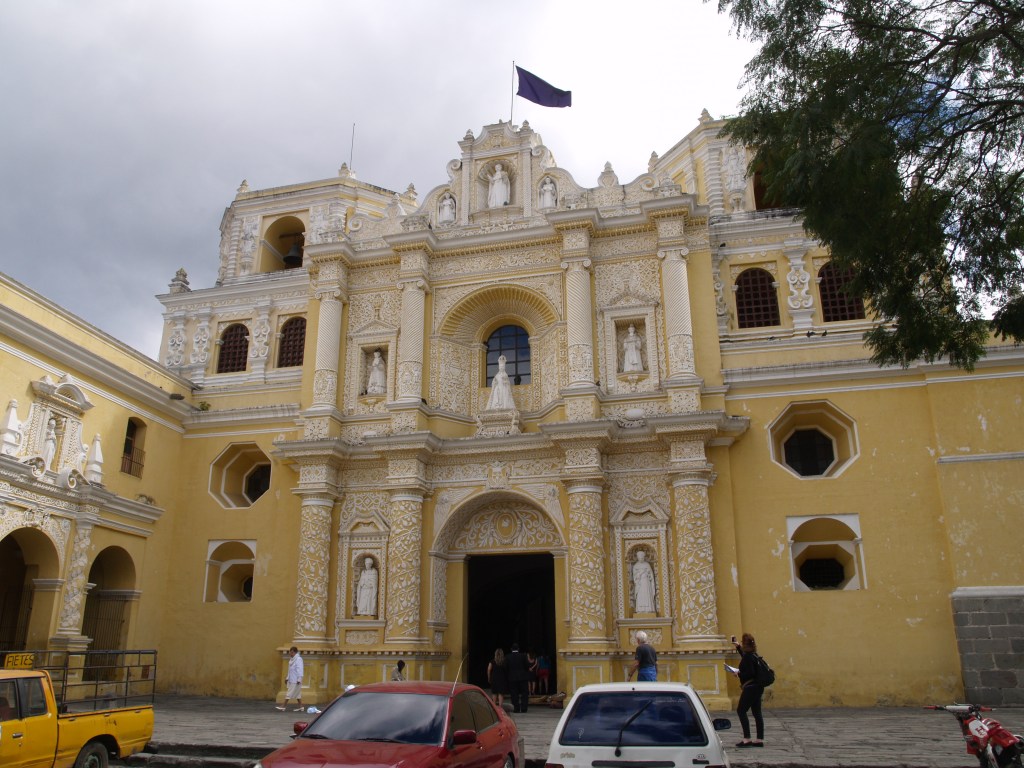
If you walk north from the Parque Central, also where the markets are, you will find the church “Nuestra Senora de la Merced”. A dream in yellow and white baroque. The interior is also impressive. A wedding has just been celebrated. The surrounding park-like garden is also beautiful. If you head back towards the central square, you pass through the beautiful archway again.
In front of it are the communal washbasins
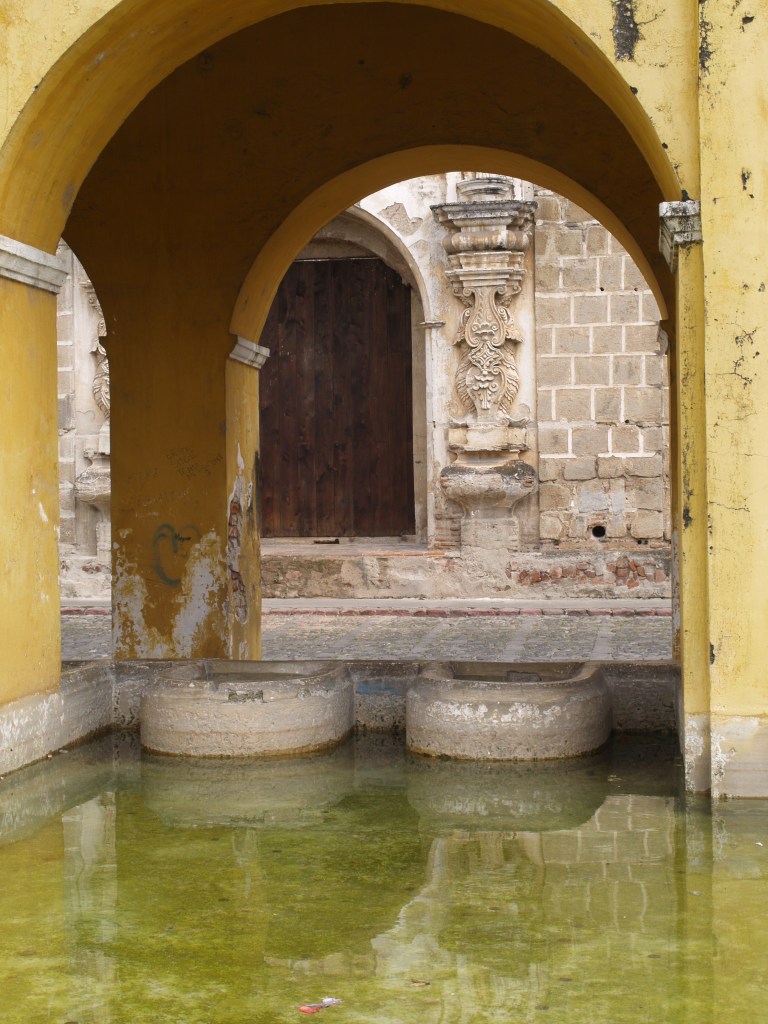
From the Parque Central in a southerly direction, after one block straight ahead and one block to the right, you will find the church of San Pedro, all in rich yellow and with a wedding ceremony (when we looked inside). Further to the right is a small park (Tanque La Unión) and behind it, the convent of St. Clare (ruins). You can get inside through the wooden door (note: opening hours). We didn’t go inside, but admired the communal laundry facilities in the arcades in front. I wonder how much laundry was washed here? My wife wondered.
At sea to Puntarenas, Costa Rica, December 7, 2014
After so much culture, we take a break today. But we don’t miss the Historic & Culture lecture. History and culture with our guest lecturer Daniel Schutzer: The history of the Panama Canal and its influence on the economy and region – the events that led to the construction of the canal and its impact on the country of Panama and the surrounding countries, 1:30 p.m. in the theater on deck 4.
Puntarenas, Costa Rica, December 8, 2014
Learning to taste coffee
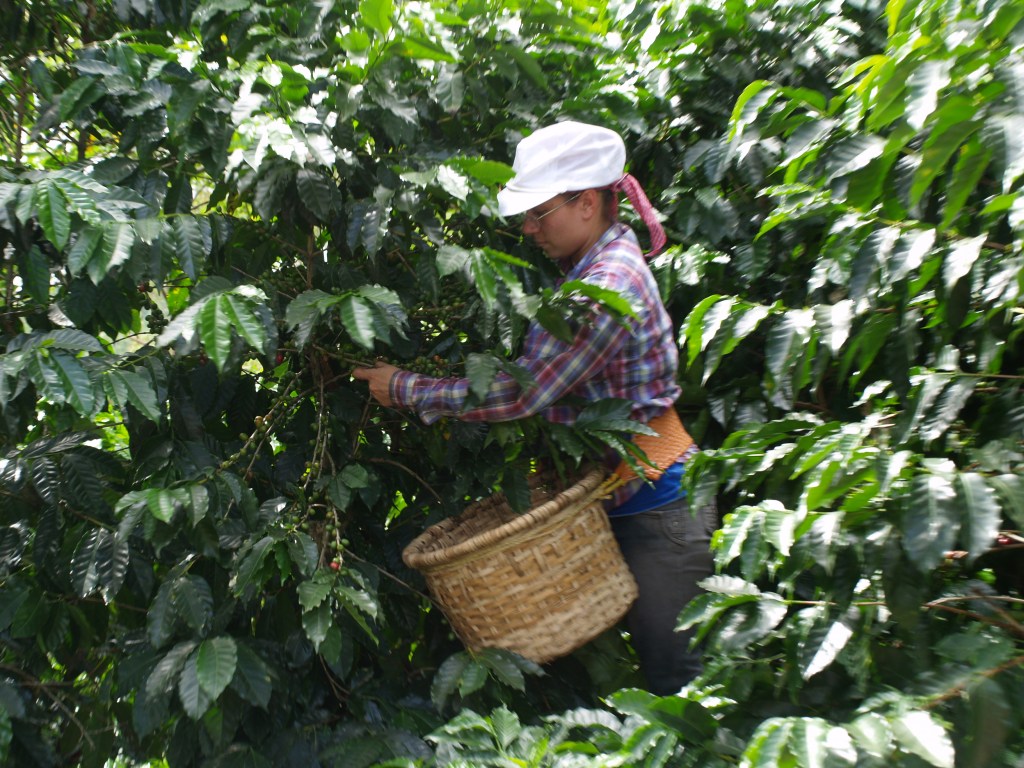
After the usual confusion, we were on the right bus to the Espiritu Santo Cooperative coffee plantation. The journey from the port of Puntarenas to the highlands takes an hour and a half. We have always been interested in how coffee is grown and processed in nutura. After the rush to the toilets, we grouped up and then headed through the plantation. With real pickers: for a basket of red coffee cherries (about 12 kg) you get 2 dollars on the hand, experienced pickers manage 10, some even 20 baskets a day. And the accommodation is free. Our guide was great. We now know what the one-year-old saplings look like, which are transplanted at the age of 2 and bear fruit after 7 years. We now know that there is a top planting, bananas or something similar, because good coffee likes shade. Then it was time to brew the coffee. Before that, the beans had to be ground, which I did with a very old but efficient coffee grinder. It tastes delicious, very different from here (even without milk and sugar). Then it was off to the roasting and drying machine, and finally to the roasting, which is what makes coffee (discovered by monks in Abyssinia). We picked up a kilo of coffee in the store, at a high price, but it goes to the cooperative. A visit to a coffee plantation is a must.
Everything is colorful here – the cart factory, even the church
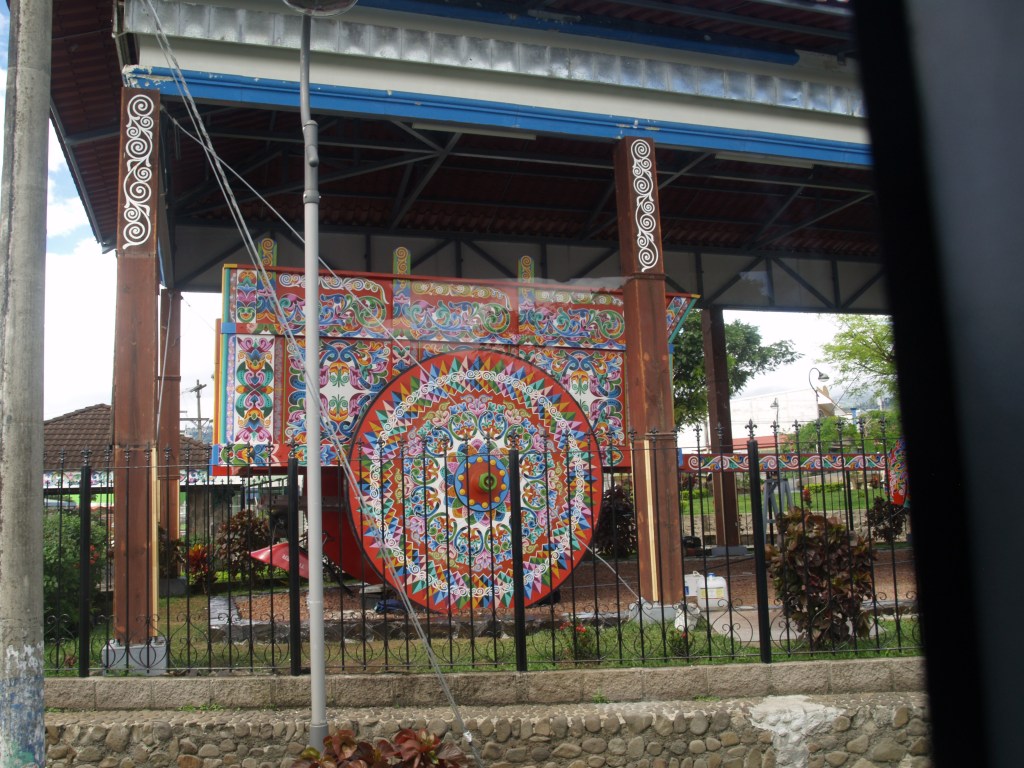
You can’t miss it, the oxcart factory in Sarchi, a colorfully painted giant cart points the way. In the past, these carts were used to move sacks of green coffee, today tourists move mini carts home, including mini oxen. The church on the square in front is also colorful, where else are there pink-painted churches?
The carts are made using a water-powered sawmill. Made of mahogany wood, they last forever. Everything that comes out of the factory is painted brightly, not just like that, but artistically. This or that souvenir goes with it. The mural is remarkable, it shows a scene from coffee cultivation and transportation: the women are light, the men dark. I should have asked.
There is a canteen on the second floor, and the buffet meal, typical of the country, was impressive. Well fortified, we went to the obligatory sales exhibition. And you have to bring something from Costa Rica with you.
At sea, heading for the Panama Canal, December 9, 2014
The Legend of the Seas had set course for the Panama Canal. This time we heard something about the Panama Canal. And we were excited to sail through it. History and culture with our guest lecturer Gary Fuller: The history of the Panama Canal engineering and widening project – engineering construction and later distribution, 14:00 in the theater on deck 4.
Panama Canal, December 9 and 10, 2014
Free sightseeing from the cruise ship
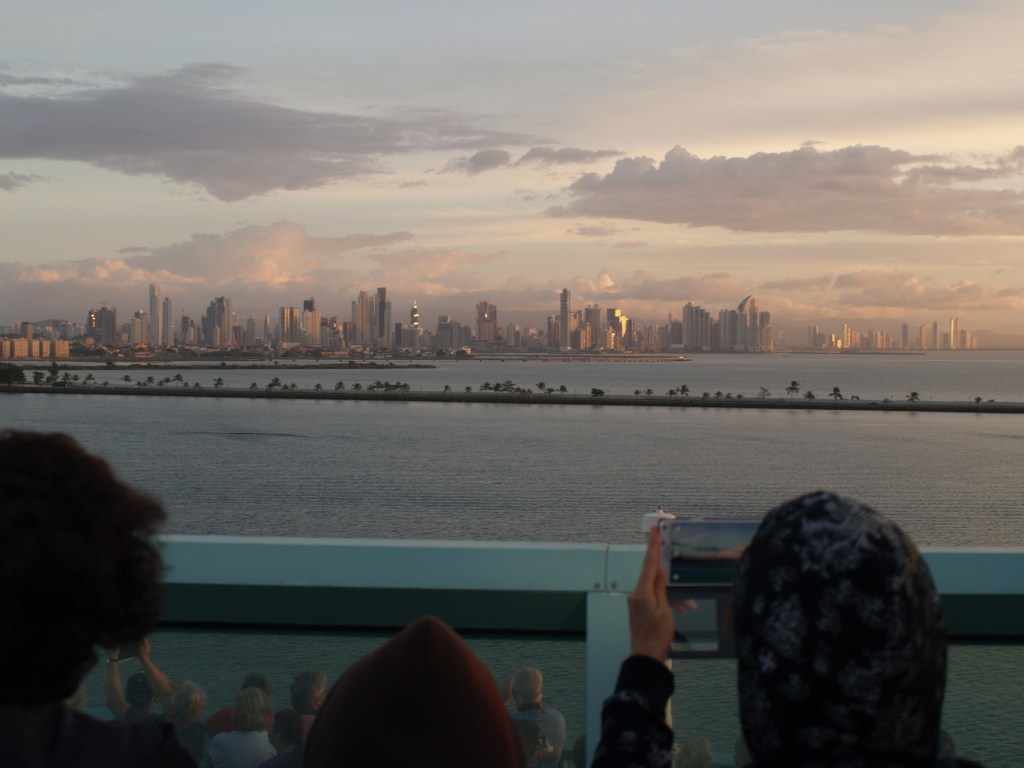
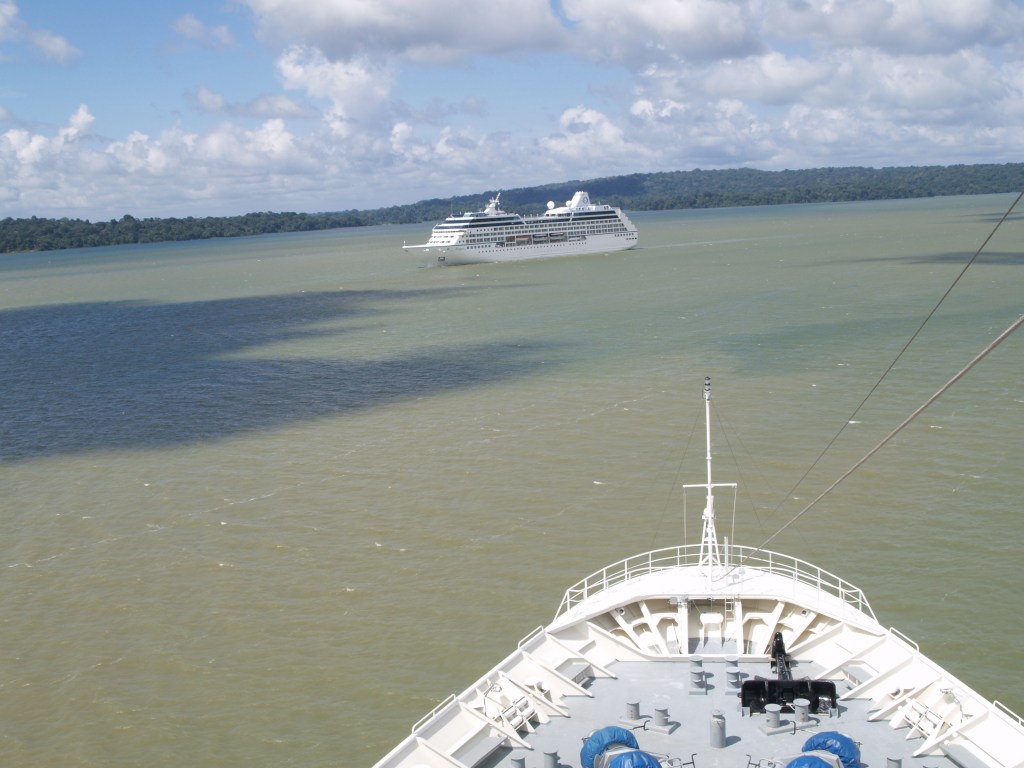
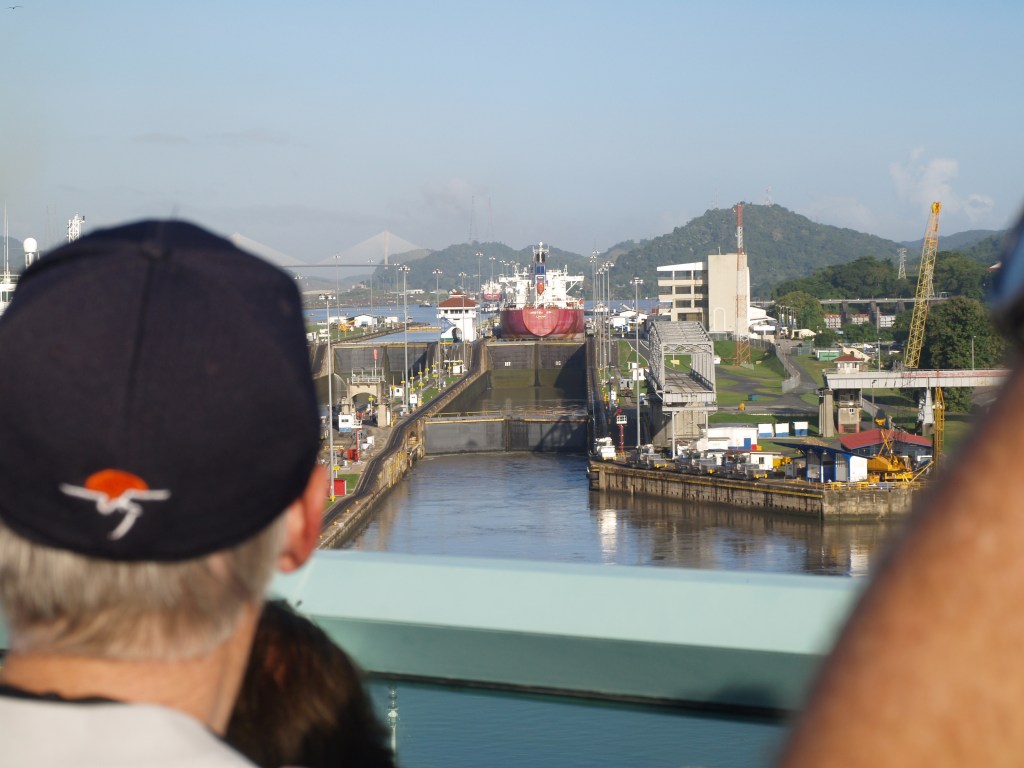
The skyline of Panama City was still in the dawn light as the ship approached the entrance to the canal. A magnificent sight. The Miraflores locks could already be seen through the Panama Bridge. Treidelloks kept the ship away from the lock walls. Then we went through the rainforest-lined canal to the Pedro Miguel locks, which raised the ship to the level of Lake Gatun. After the passage, we went downhill again via the Gatún locks. And finally, the next day, we reached Colon (Cristobal) in the Caribbean. There was plenty to do from here: Excursions to the Indians, to the Gatún locks or simply across the street to the free trade zone. You have to go through the Panama Canal once in a lifetime. The canal authority gave us a brochure, the contents of which I found very informative, describing the creation of the sea route, how the locks work and what expansion work is planned or already underway on the canal.
Colon, Panama, December 11, 2014
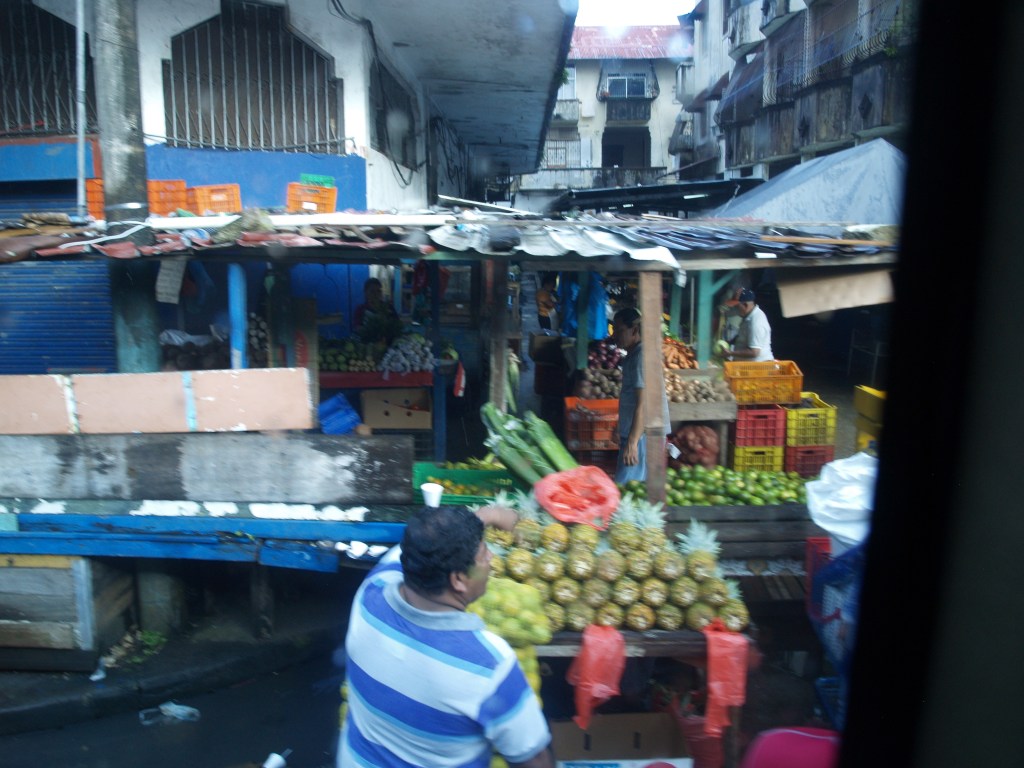
The ship has passed through the Panama Canal, arrived in the Atlantic and is now moored in front of the Colon Free Trade Zone. What can you do there? Disembark and take a look around the large walled and not very trustworthy free trade zone. It’s only dangerous to go further out to the train station if accompanied by police officers. We didn’t do that, instead we booked an excursion to the Gatun locks and then to an Indian tribe in the rainforest. More about this in a moment.
Where the ships are lifted by 23 meters
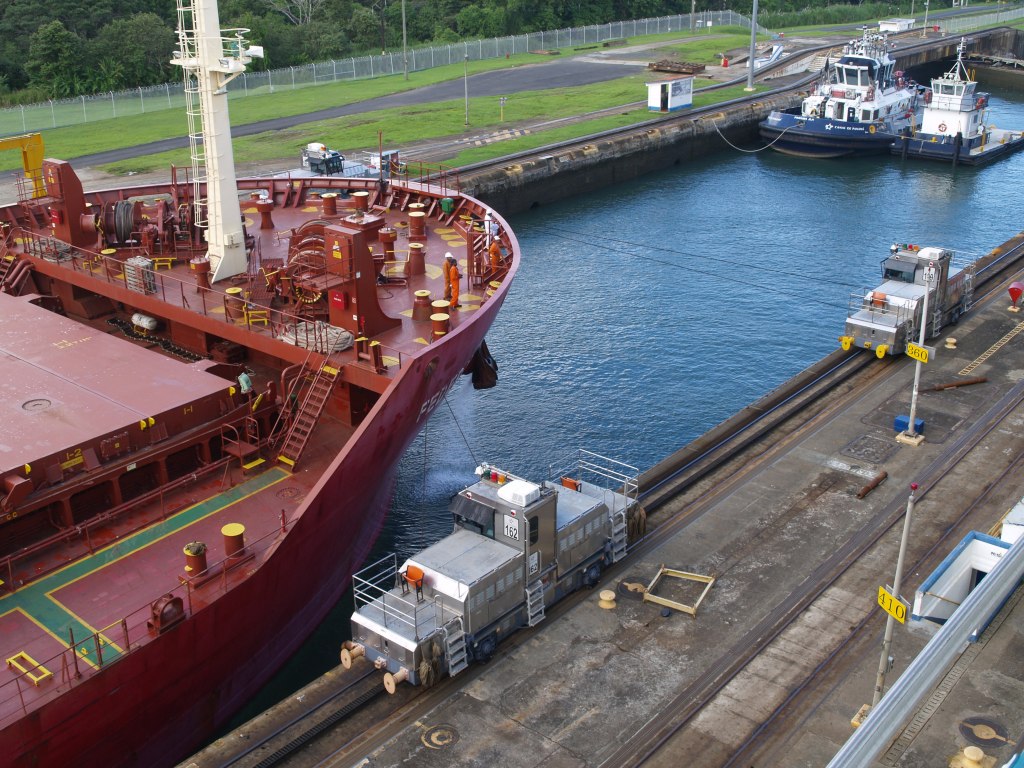
Ships coming from the Atlantic are lifted through the Gatún locks to the level of Lake Gatún. We decided to watch this. We took the bus through the huge construction site for the canal expansion to the lock house. From the visitor platform, you can see how the locks are operated. Six locomotives run in parallel to keep the ship centered. They are connected to the ship via cable winches. The ship itself provides the propulsion. Locking takes place through 2 x three chambers (parallel). The old locomotive in front of the lock house invites you to take a photo with your loved ones.
Welcome to the Embera Indian tribe
From the Gatun lock, the bus drove to an impressive hotel complex on Lake Gatun. From there, we continued on small excursion boats along the banks of the rainforest. And indeed – there were monkeys sitting on the treetops, I can’t say what kind. Then everything called, a sloth, by which the Americans mean a sloth. It was lolling leisurely in the branches.
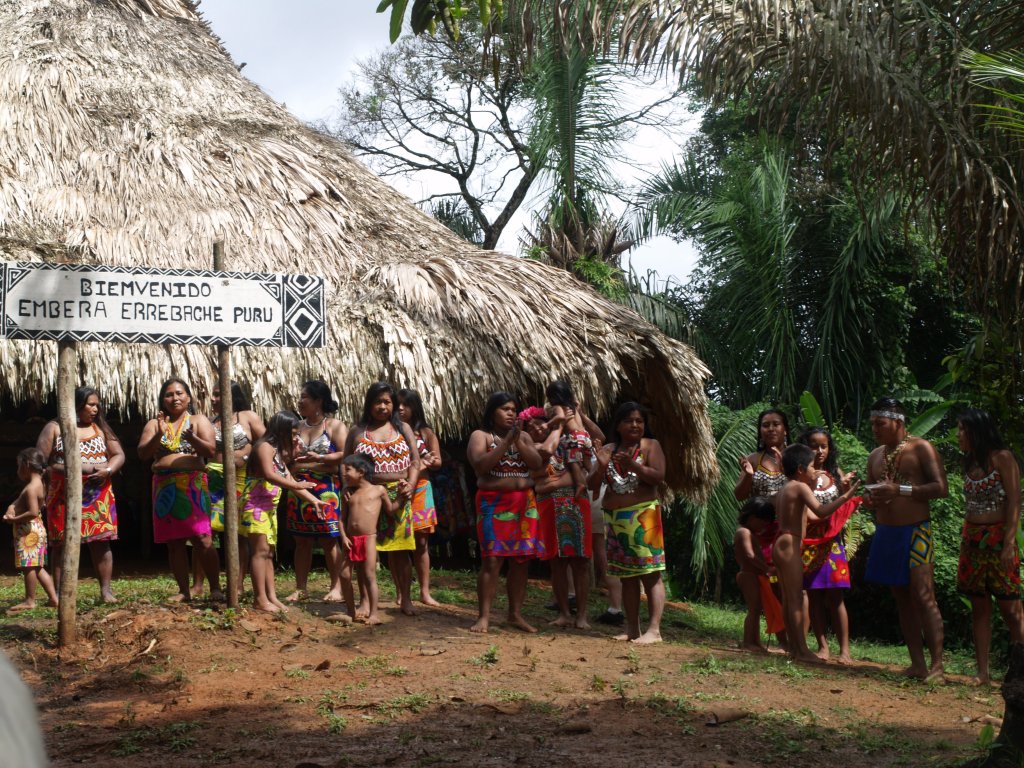
We continued on to the Embera Indians. The men played music and the women danced, the cute little ones joined in with both. Then they showed us their village and the handicrafts that were for sale. Nice things at a reasonable price. The Embera are actually at home in the interior of Colombia. They came here to teach the US troops how to fight in the jungle. They stayed and are happy to take the money from the tourists. Despite everything, it is an insight into a culture that is foreign to us.
Cartagena fiasco
Then it happened – our Cartagena fiasco. We were sitting comfortably in the Diamond Lounge after dinner. My wife just had to leave. Then I heard the loudspeaker announcement “Code Alpha, Code Alpha, Code Alpha.”, meaning emergency on board. A short time later, the concierge grabbed my hand and showed me “the salad”. My wife had fallen in front of the elevator and suffered a fractured neck of femur. She recognized it as such because it had already happened to her once on the other side. So off to the ship’s hospital, where her body was immobilized and a catheter was inserted. The patient was pushed into the hospital cabin.
The administrative part remained for me: filling in the forms to prove that she was not at fault. Informing the emergency medical insurance office, clearing the cabin, which a 3rd officer helped me with. Pack my bags and off to the sick room, rooming. An excitement there and a restless night.
The ship was already on its way to Cartagena de Indias, Colombia. On arrival, the plan was to take my wife to a private clinic where she would be operated on. This had to be agreed with the health insurance company. We, the 3rd officer and I, spent some time on the satellite phone. We also had to inform the Colombian immigration authorities.
Cartagena de Indias, Colombia, December 12, 2014
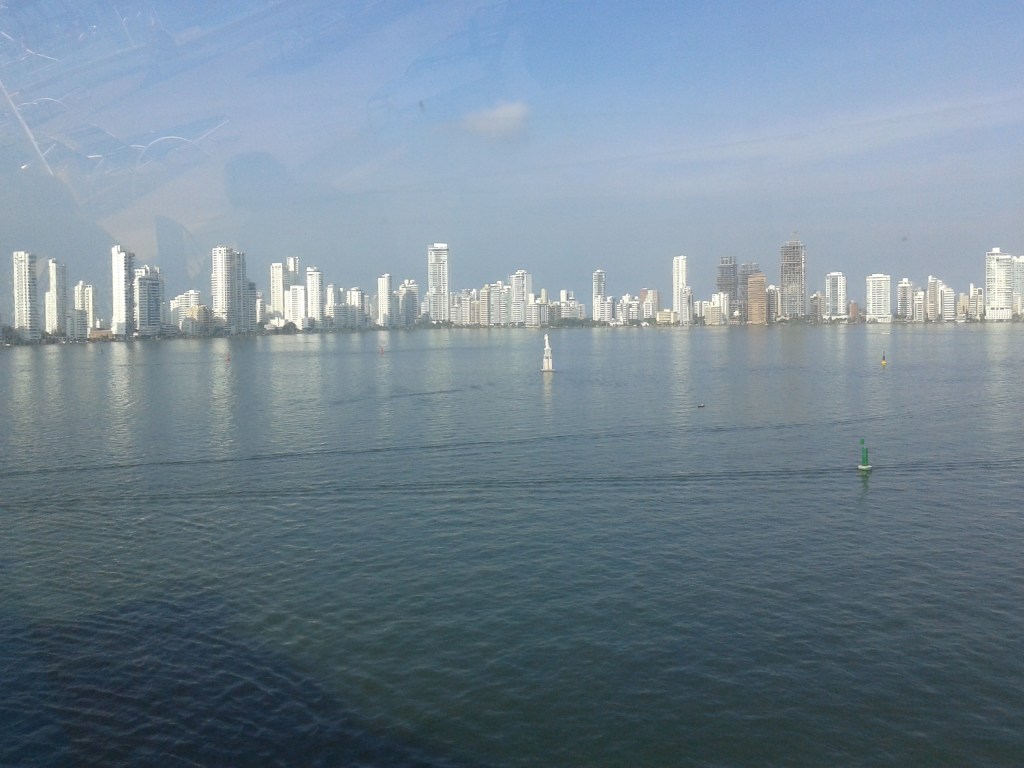
I awaited the day with mixed feelings. We were taken off the ship early and the ambulance was already waiting. It drove us to a private clinic in the Bocagrande district (loosely translated as “big mouth”). This is located on a peninsula with white high-rise apartment buildings. As we learned later, the apartments there are mostly on one floor and were not intended for the socially disadvantaged, i.e. not for 85% of Colombia’s population.
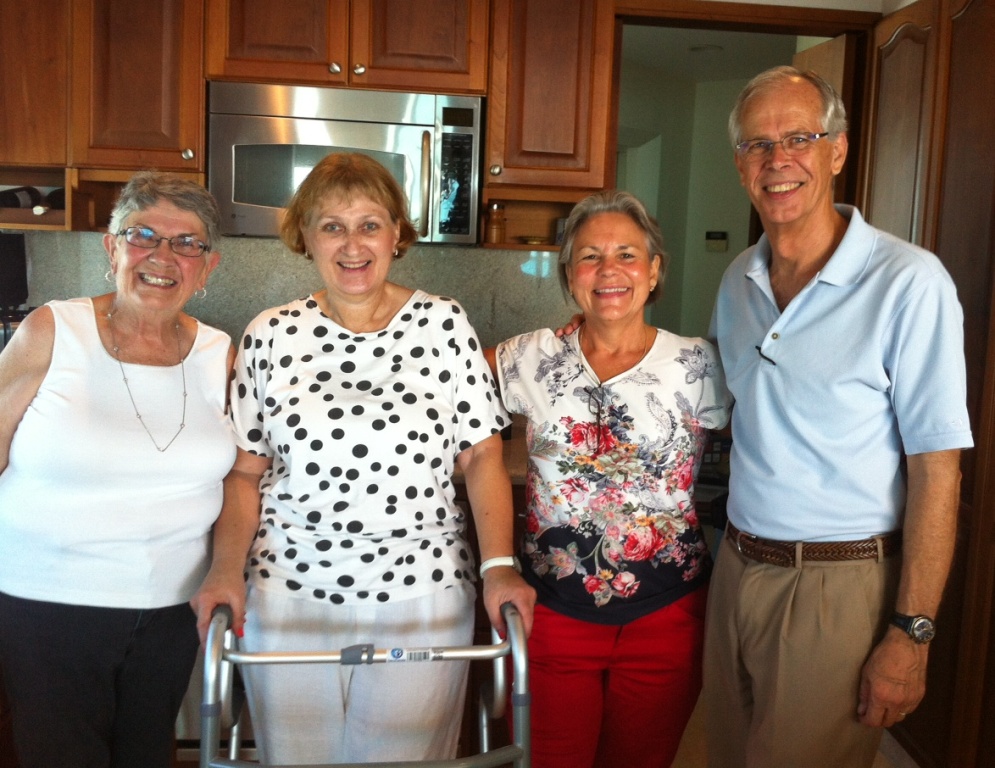
At the clinic, we were welcomed by Dan and Berit, U.S. Americans who looked after stranded people like us. They called themselves Friends of Columbia and had set up an association (foundation). The diagnosis showed that a semi-prosthesis had to be inserted, the lower part of the hip joint. This could be inserted tomorrow, then the implant would be there. However, an advance payment of 15,000 dollars was required. Our new friend Dan arranged this with the insurance company. So my wife was moved to one of the best rooms and awaited the operation the next morning. Dan and Begit also took care of me. I was given a guest room in their very large apartment overlooking the sea between the Isla de Terra Bomba, where the cruise ships also had to pass through to get to the harbor. In the evening, they invited me to an indigenous restaurant.
Cartagena de Indias, Colombia, December 13, 2014
My wife was operated on in the morning. She came through the operation well, Dan, who spoke to the doctor on the phone, told me. We can visit her in the afternoon. In the meantime, there was still a lot to organize. The plan was for Dan and Berit to look after my wife at home until she could fly back. We then withdrew money together for this. I also booked the flight to Miami. It’s due to take off tomorrow so that I can get the regular return flight in Miami.
We visited my wife in the afternoon and she was doing well under the circumstances. We told her that she would be looked after privately by a nurse from the clinic. When I was in Germany, I would make further arrangements. Then we let her rest. A short farewell.
Our ship was in the Gulf of Mexico and ended the cruise in its home port of Miami. We received a certificate for the Panama Canal crossing.
Evening in the old town
I had invited my Colombian friends to dinner. Oh, they said, we know a German restaurant in the old town. No sooner said than done, we set off in the direction of Castillogrande in the Feliz Navidad-pregnant city. I’ve never seen Christmas magic like this before, the Christmas markets in Cologne are nothing compared to it. We parked somewhere near the 400-year-old wall. Off we went through the alleyways, very beautiful and romantic. The German pub with the name “Le Petit” was not really a German pub, except for the draught beer, brewed in Bogota. There was dark bock beer, Münchener Hell and Märzen (which I only know from Franconia). And there was a German Patrone (from my home town of Berlin). The conservation was accordingly. He said that German food wasn’t good at all, so we switched to Caribbean food, very tasty. On the way back, we popped into an old luxury hotel. The atrium was fantastic. We would like to stay there one day.
Cartagena de Indias, Colombia / Miami, United States, December 14, 2014
It wasn’t quite light yet when Dan and Berit drove me to the medium-sized airport. There was a fond farewell and a photo to match. There were still some departure formalities: I got part of my visa fee back and I was searched for drugs. The flight over the Gulf of Mexico took just under 3 hours with Avianca (Colombian airline). I spent a few hours at Miami International Airport, but not long at immigration. I already knew differently. In the evening, the Lufthansa flight to Frankfurt took off, with a brand new Airbus A 380, full with a take-off weight of 430 tons. It was a very pleasant flight, spacious, quiet and fast.
What a cruise!
First across the United States, stopped off in the gamblers‘ paradise of Las Vegas, flew over the Grand Cannon and went for a drive in Death Valley. We got to know a bit of California and the beaches of Mexico. Explored the World Heritage Site of Antigua in the former capital of Guatemala and drank real coffee in Costa Rica. Then we traveled through the Panama Canal, visited an Indian tribe and saw how the large canal locks work. It was all great.
I want to finish my story about the fiasco. After a short stay in hospital, my wife “came home” to Dan and Berit. Shortly before Christmas, the doctor came from Germany to pick her up. She then flew comfortably in Business Class to Frankfurt Airport and was transported to Cologne by ambulance. Because she didn’t want to spend Christmas in hospital, I and my daughters took her home. She arrived in the ambulance. Cruise adventures can also end like this. It was nice to be together on Christmas Eve after all.
 The highs and lows of cruising, sometimes described in literary terms